How Much Does a Radio Ad Cost for Small Business?
There’s a question I hear all the time, and it usually comes with a slightly nervous tone behind it.
“How much does a radio ad actually cost for a small business?”
And underneath that question is usually something else entirely: “Can I afford this… or am I about to waste my money?”
I’ll be honest, I’ve been on both sides of that feeling. The asking and the answering. And there’s always that moment of hesitation where you wonder if the number you’re about to say is going to open a door or shut one instantly.
But here’s the truth: radio pricing isn’t just about cost. It’s about understanding what you’re actually buying.
For a simple local campaign, the structure is usually very straightforward.
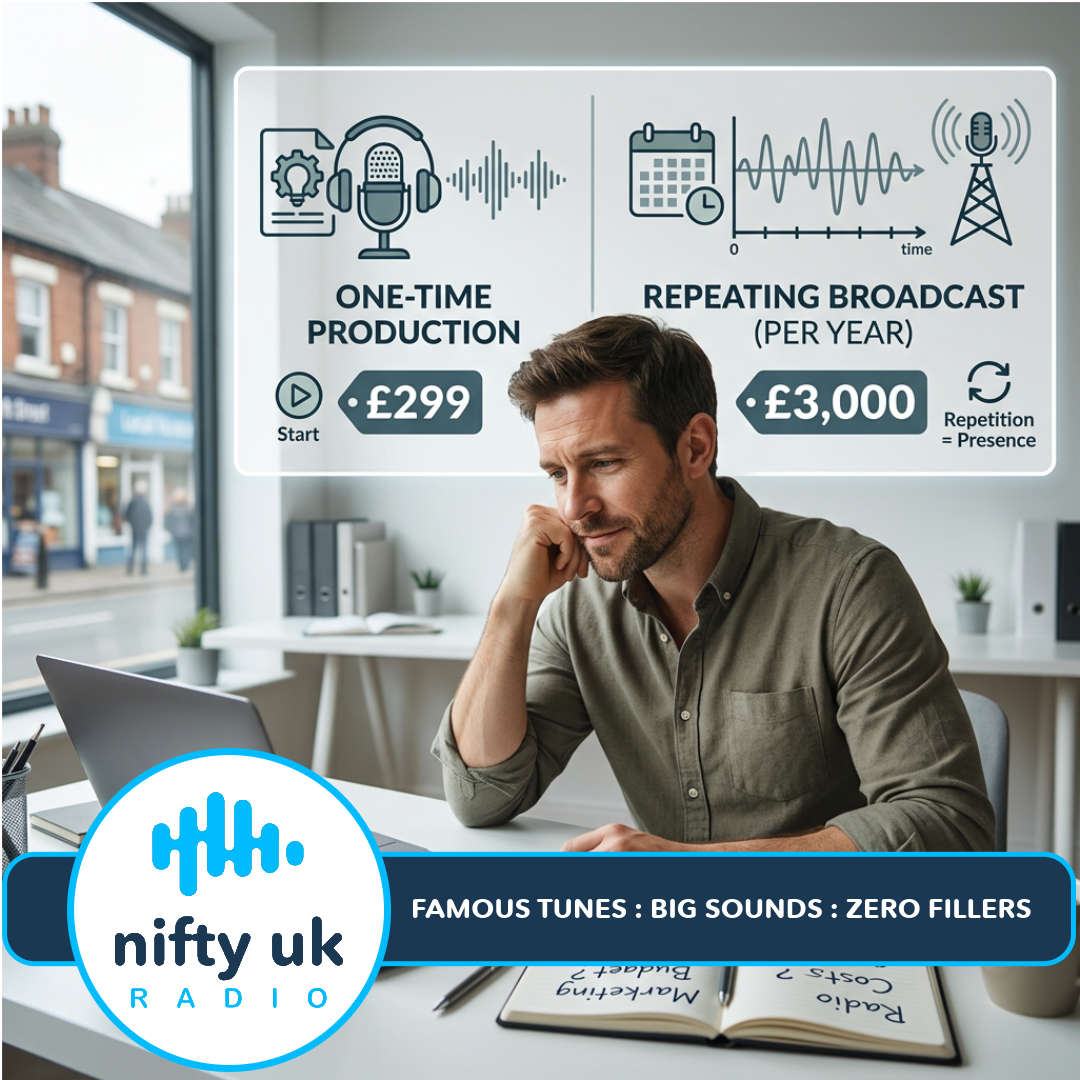
Production is typically around £299. Broadcast cost is around £3,000 per year.
That £3,000 doesn’t buy you a single moment. It buys you repetition. It buys you presence. It buys you something far more valuable than a one-off advert—it buys you consistency.
In practical terms, that means your advert is being played multiple times every single day, across a full 24-hour cycle, spread across different listening moments so it becomes part of people’s everyday routine rather than a one-off interruption.
You’re not buying a slot. You’re buying frequency.
And frequency is where radio lives or dies.
The biggest misunderstanding small businesses have is thinking radio works like a digital vending machine. Spend money, get instant clicks, watch sales appear on a dashboard the next morning.
That’s not how it works.
Radio is not built for instant response. It is built for memory.
People hear your message while driving, working, living their day. They don’t stop and act immediately. They store it. Then weeks later, when something breaks, when something hurts, when something becomes urgent—that memory suddenly matters.
That’s when radio converts.
Not in the moment. In the moment of need.
I’ve seen this play out repeatedly in real businesses.
One of the strongest examples I’ve ever seen is a local physiotherapy clinic in Shaw. The owner committed to a full year of advertising. For months, nothing dramatic happened. The phone didn’t explode. There was no instant “viral moment”. Other businesses started questioning it.
But he understood something important: nobody books a physio casually. You only need one when something goes wrong.
Then winter hit.
Suddenly the phone started ringing constantly.
And when new patients were asked how they found the clinic, the answer was almost identical every time: “I’ve heard you on the radio for months. I didn’t need you then—but I hurt myself today, and you were the first name that came into my head.”
That is radio working exactly as it’s supposed to work.
Not instant clicks. Instant recall.
One of the biggest mistakes businesses make when deciding budgets is spreading small money too thin. They try to reach everyone instead of being remembered by someone.
Reach without frequency is basically wasted energy. It sounds impressive on paper, but if someone only hears your message once, it rarely sticks.
It’s far more effective to be heard consistently by a smaller audience than occasionally by a huge one.
And when people say “radio didn’t work for us,” the reality is usually very simple. The script was overloaded, the campaign was too short, or the budget was stretched so thin that nothing ever had a chance to actually land in the listener’s memory.
They check their website the next morning, see no immediate spike, and assume failure.
But radio doesn’t behave like that.
It builds slowly. Quietly. Repeatedly.
And often, it only proves itself when you stop doing it.
That’s when the phone goes quieter, the enquiries dip, and you realise something was holding everything together in the background without you noticing.
So what does radio actually cost a small business?
In reality, it’s not just a financial question. It’s a structural one.
A £3,000 broadcast investment is not expensive when it becomes a daily presence in your local area. Especially when you consider it is being heard repeatedly by a large, consistent audience across an entire year.
But the real mistake isn’t the cost. It’s the misunderstanding.
Small businesses often treat radio like digital advertising. They expect immediate attribution, direct clicks, and dashboard clarity. But radio operates differently. It builds subconscious familiarity, not instant conversion.
And when it works, it works quietly in the background until the exact moment it matters.
Radio still works in 2026 because it is one of the last truly unskippable, screenless companions in people’s daily lives. It doesn’t demand attention. It shares it. It sits inside commutes, workdays, routines, and real physical life.
No swipe. No skip. No interruption fatigue. Just presence.
And presence builds memory.
If there’s one thing I’ve learned, it’s this:
Radio doesn’t win because it is loud. It wins because it is consistent.
And consistency is what makes a business the automatic choice when a customer suddenly needs one.
To make radio advertising actually work, a small business must commit to a single, hyper-simple message repeated so consistently that your brand becomes the automatic, subconscious default choice the exact second a local consumer hits a moment of crisis.